
Read Your PPC Account Like a Book: The Column Layout That Tells the Story
By Luke Zgaga · · 7 min read
Open any PPC account and you are met with a wall of numbers. Impressions, clicks, CTR, cost, CPC, conversions, CPA, conversion value, impression share — dozens of columns, thousands of rows, all competing for attention. It is genuinely overwhelming, and it is where a lot of time gets wasted staring at metrics in isolation. So the first thing we do in a new account is not touch a bid or a budget. It is reorder the columns.
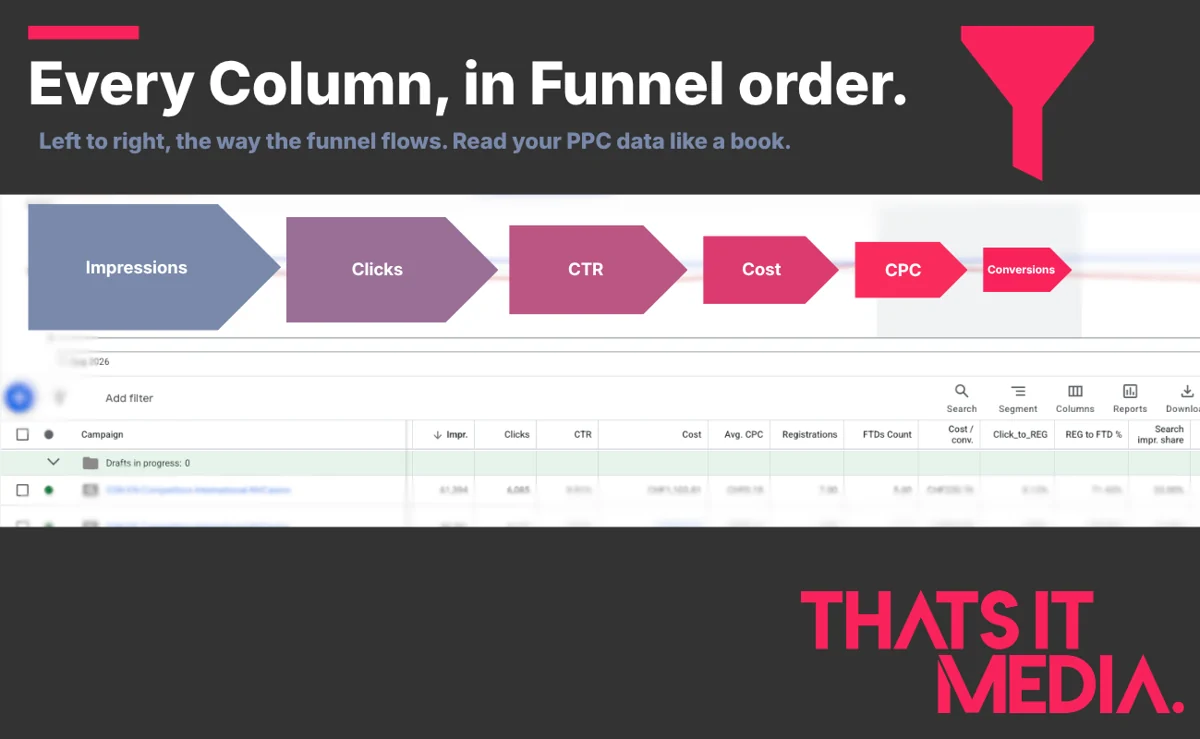
Put the columns in funnel order
The trick is simple: arrange the columns left-to-right in the exact order the funnel actually happens. First an impression. Off the back of that, a click. Those two together give you a CTR. The click costs money, so next comes cost, and from cost and clicks you get CPC. Then the outcome — conversions — and finally CPA. Impressions → clicks → CTR → cost → CPC → conversions → CPA. Nothing is added or removed; it is the same data, simply sequenced the way the customer journey unfolds.
Why isolated metrics overwhelm — and ordered ones don't
A number on its own tells you almost nothing. A 2% CTR is neither good nor bad until you see the impressions feeding it and the cost coming out the other side. When the columns are scattered, your eye jumps around trying to assemble the relationship in your head. When they run in funnel order, the relationship is already on the page. You stop reading isolated figures and start reading a sequence — and a sequence is a sentence. The table turns into prose you can read left to right, like a book.
Each row becomes a story you can read at a glance
Once the account reads like a book, problems announce themselves. Plenty of impressions but a weak CTR? The story is relevance or creative — you are being seen and ignored. Strong CTR but a punishing CPC? That is an auction and quality-signal story. Clicks pouring in but no conversions at the end of the line? Now the story is the landing experience or the tracking, not the ads. You are no longer hunting through columns; you are reading where the narrative breaks down, and the break tells you exactly where to act.
The funnel changes with the view — so change the columns
The same principle works at every level of the account. You just reframe the funnel around whatever you are looking at:
- Ad view — centre the funnel on CTR. Impressions, clicks and CTR are the story of whether the creative earns the click; the conversion metrics sit alongside for context.
- Search-term view — centre it on conversions and CPA. Here you are hunting for waste to negate and winners to promote, so the money question is what each term actually costs to convert.
- Campaign view — run the full conversion funnel, then add impression share. That last column is the crucial one: it shows how much demand exists outside the funnel you are reading — the headroom you have not captured yet.
Data tells a story — reading it fast is the job
PPC is one of the most data-rich channels in marketing, which is exactly why structure matters so much. The numbers always contain a story; the platform just presents them in an order that hides it. Our job as performance marketers is not to admire the dashboard — it is to read the story quickly, know which chapter is failing, and report it back to a client or a board in plain, confident English. Reordering the columns is a small habit, but it is the one that turns an intimidating grid into a clear account of what is happening and what to do next.
It is a five-minute change with an outsized payoff, and it is the discipline underneath how we run performance media — part of buying every paid channel like performance. Pair it with how Google Ads actually works in 2026, where clean data and clear reading matter more than ever.